
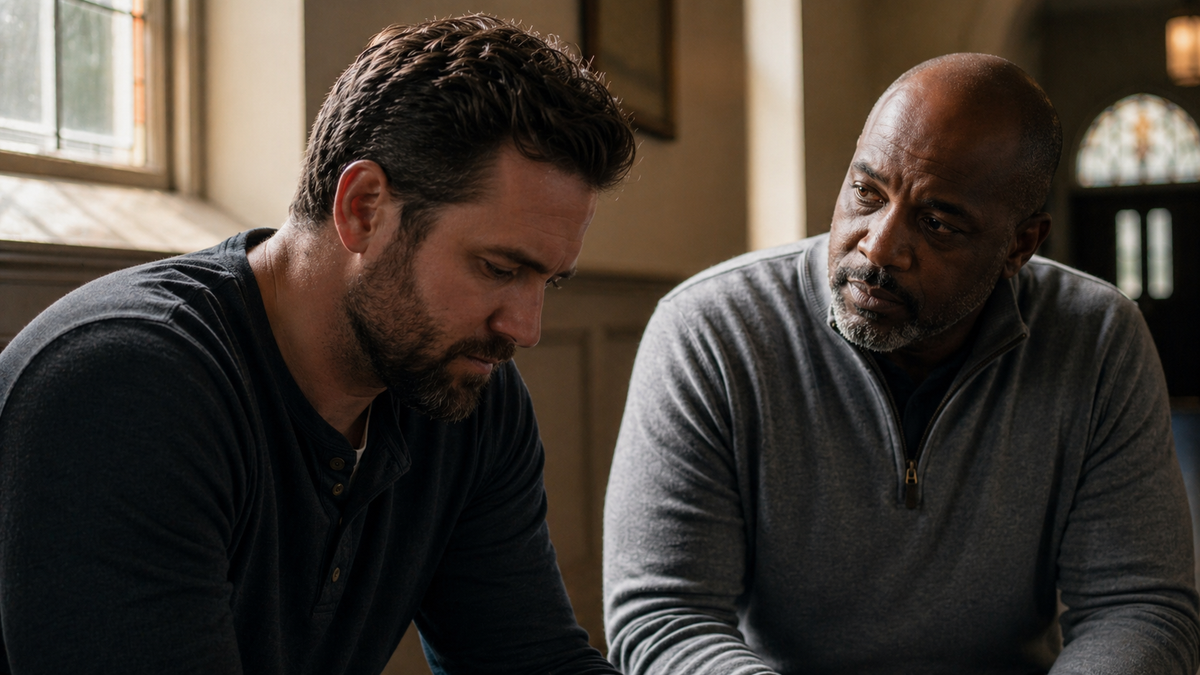
Some burdens feel impossible to share.
They've become a pattern. Ingrained in our memory. A temptation we can't resist. We're weighed down by our search history, a secret habit, confusion, resentment, old wounds—things we keep promising ourselves we'll deal with later.
For many of us, the hard part isn't knowing what's true. Sometimes it's in believing we could be completely known and still accepted.
So what should a Christian man do with hidden shame?
We have a savior who longs to carry our burdens. For in the light of Christ, shame doesn't have to become our name. This grace becomes real when we tell the truth to a trusted brother or pastor, and take the next faithful step of repentance, care, and hope. Not everyone needs to know everything, but secrecy keeps us in a life of surviving and not thriving.
Shame is not your name
Before we talk about confession, accountability, or change, we need to look at what Scripture says about a man who belongs to Christ:
“There is therefore now no condemnation for those who are in Christ Jesus.” — Romans 8:1
That doesn't mean sin is harmless, repentance is optional, consequences disappear, or that every wound heals overnight.
It means condemnation is not the voice of God over the man who is in Christ.
Conviction tells the truth and calls us toward God. Shame twists the truth and tells us to hide from Him. Conviction says, “Come into the light.” Shame says, “If anyone really knew you, you'd be finished.”
That second voice isn't shepherding you toward life.
Some of us have lived for years under the fear that our worst struggle defines us. We may still go to church, work hard, provide, serve, and look steady enough from the outside. But inside, we carry a private sentence over ourselves.
Unclean. Disqualified. Too complicated. Too weak. Too much. Not enough.
The gospel doesn't let us minimize sin. But it also doesn't let shame rename a man whom Christ has claimed.
Tell the truth without turning your story into a spectacle
One reason men stay hidden is that we confuse honesty with exposure.
We think telling the truth means everybody must know everything. We imagine a public collapse, a dramatic confession, a permanent label, or a conversation we'll never recover from.
That's not what this article is calling you to.
Walking in the light doesn't mean broadcasting your life. It means you stop living in the dark before God and stop carrying serious burdens with no faithful witness, no prayer, no help, and no path toward repentance.
First John says that "if we walk in the light, we have fellowship with one another, and the blood of Jesus cleanses us from all sin." The light is not where God humiliates His sons; it's where cleansing and fellowship become real.
For some men, this means confessing sin clearly to a trusted brother. For others, it may mean talking with a pastor, counselor, or mature Christian man who can help you respond wisely. If your hidden life has harmed your wife, your family, or someone else, truth may need to move beyond one brother into repair, confession, and accountability with those affected.
But don't get ahead of yourself. Start by trading secrecy and shame for the sufficiency of Christ.
Learn the difference between temptation, behavior, shame, and identity
This is where I and many other men have struggled.
A lot of us carry shame because everything feels tangled together. Temptation, desire, fear, memory, behavior, attraction, habit, guilt, regret, and identity all get shoved into one dark room. After a while, we stop sorting anything. We say, “This is who I am,” or "No one needs to know," and hide.
But Scripture tells us differently.
Temptation is real, but it's not the same thing as identity. Being tempted doesn't mean you're beyond grace. Jesus Himself was tempted, yet without sin. Temptation is going to happen, and we can bring it honestly before Christ.
Behavior matters too. If we have sinned, we shouldn't soften it, spiritualize it, or rename it as stress. Confession means telling the truth about what we've done, not just how we feel.
Shame adds another layer. It often says, “Because this is part of your story, it's the whole truth about you.” But the deepest truth about a Christian man is not his worst act, strongest temptation, confusing desire, or most painful wound. The deepest truth is that he belongs to Christ.
And our ultimate identity isn't something we invent out of our struggle, what others have told us, or what we've internalized. For the Christian, identity is received from God. We are sons by grace, not performers trying to earn our place.
That distinction matters for men who wrestle with unwanted sexual patterns, attractions, identity confusion, or stories they have never known how to say out loud. The fear of mockery or vague reassurance won't move us toward freedom. We need truth with mercy and moral clarity without being reduced to one struggle. We need brothers who can help us walk honestly with Christ over time.
Bring the burden into the light with the right man
Hidden shame grows stronger when it stays unnamed.
Most of us know this from experience. The thing we never say gets heavier. The part of the story we always edit becomes harder to bring up. The longer we hide, the more impossible honesty feels.
But Galatians 6 says that restoration and burden-bearing belong inside the Christian life. If a brother is caught in sin, the response is not mockery or ego. It's restoration in a spirit of gentleness while being ever-ready to bear his burdens. It's truth with care.
That means we need at least one faithful man who knows more than the public version of ourselves.
You may have tried in the past and been burned. Christian men who don't take their calling seriously may just be curious about your struggles or not keep your confessions in confidence. Or perhaps you've encountered others who simply enjoy being needed or only know how to offer judgment and shame.
You need a true, Christian man.
Someone grounded in Scripture who is just as serious about sin as he is about grace. Someone who will not flatter you, panic over your sin, or treat your struggle as entertainment. Someone who can pray with you, ask direct questions, and help you take the next right step.
You might start with one sentence:
“I need to tell you something I've been carrying alone.”
Or:
“I'm ashamed of part of my story, and I need help bringing it into the light.”
Or:
“I don't need you to fix me in one conversation. I need you to hear the truth and help me keep walking.”
That kind of honesty may feel like weakness, yet it's anything but. It's one way we stop letting shame rule over us.
Repentance is real, but it's not without consequences
You may be avoiding telling the truth for fear of what comes next. I've been there.
What if I confess and still struggle?
What if I tell a brother and don't feel better right away?
What if repentance is slower than I want it to be?
What if this is more complicated than one conversation?
Those are honest fears.
But repentance was never meant to be a performance where you prove you're instantly fine. Repentance is a real turning toward God. Sometimes it starts with tears or a shaky sentence. Other times it starts with deleting something, ending something, confessing something, making a call, blocking access, getting counseling, or asking a brother to check in every week.
We all want instant healing.
But first, stop protecting what's killing you.
Sanctification is often slower than our pride wants, but slow progress is better than no progress. This might mean you feel weak while still walking in truth. You will certainly need help along the journey. But no matter how long the road, with Christian brothers, you can take a real step today knowing Christ will not let you fail.
One faithful step this week
Don't try to explain your entire life tonight, but take one faithful step.
Before this week ends:
- Name the burden honestly before God. Use plain words. Don't hide behind “I’m struggling”—God can handle the truth.
- Write one sentence you need to say to another man.
- Choose one faithful brother, pastor, counselor, or mature Christian man.
- Ask for a real conversation, not a vague check-in.
- Tell him what kind of help you need: prayer, accountability, counsel, confession, follow-up, or help taking a concrete step of repentance.
- And when shame tells you to wait until you feel stronger, remember this: hiding has not made you stronger. It's only made you harder to reach.
Christ isn't surprised by the truth about you. He isn't waiting for you to become impressive before you come near. Hebrews says we can draw near to the throne of grace to receive mercy and find grace to help in time of need.
And we are always in need.
Conclusion
Hidden shame wants to isolate a man from God, true brotherhood, and hope.
Christ calls men into the light.
That light may feel costly at first. It may include confession, repentance, repair, accountability, and long obedience. But it isn't the light of condemnation. It's the light where grace tells the truth and begins to make us whole.
Brother, your struggle is real. And you are more than your struggle. Bring one hidden burden into the light with one trusted brother, and take the next faithful step with Christ.
Take one honest step. Tell one faithful man the part of the story shame has trained you to hide.